Introduction

Neurai is a proof-of-work blockchain built for connected devices. It gives IoT hardware, from a small ESP32 board to industrial equipment, a way to hold its own cryptographic keys, exchange encrypted messages and own or transfer tokens without depending on a company's servers.
This page explains why the project exists, what is running today and what is coming next. If you just want to get started, go to the Quick Start.
Some of the features below are part of POSITRONIC, the next protocol upgrade. They already run on the public testnet and are marked with a label like this: Coming with POSITRONIC
Why we built it
Connected devices are hard to keep secure. They ship with fixed firmware, stop receiving updates after a few years, and usually depend on a manufacturer's cloud. When that cloud is breached or shut down, the devices become a liability. Central servers also see every message the devices send.
Our team has spent years building IoT systems on microcontrollers such as the ESP32, including its RISC-V variants. We wanted a security layer these devices could use directly: keys they control, messages that only the intended recipients can read, and a public ledger to check who owns what. A blockchain provides that ledger, so we built Neurai around one.
The network
Neurai has been running on mainnet since April 2023. It is a Layer 1 chain derived from the Ravencoin codebase, which is itself a fork of Bitcoin.
| Consensus | KAWPOW proof of work, GPU friendly and ASIC resistant |
| Block time | 60 seconds |
| Maximum supply | 21,000,000,000 XNA |
| Assets | Native on Layer 1, no smart contracts required |
| Launched | 17 April 2023 |
The full list of parameters is in Specs.
We chose Ravencoin's code for three practical reasons:
- Native assets. Tokens, sub-assets and unique (NFT-like) assets are part of the protocol itself. There is no contract code to write or audit.
- Bitcoin lineage. The transaction model, the UTXO set and the peer-to-peer code have been running in production for well over a decade.
- Accessible mining. KAWPOW is designed to run on consumer GPUs, which keeps mining open to individuals.
On top of that base we have added our own pieces: a token type for devices, the DePIN messaging system, tooling for microcontrollers, and the changes that arrive with POSITRONIC. The sections below describe each one.
Assets
Assets are the foundation of everything else in Neurai. Creating one burns XNA, which prevents spam and ties asset creation to the coin supply: coins created by mining are removed from circulation when assets are created.
An asset can be a main asset (COMPANY), a sub-asset (COMPANY/SENSORS) or a unique asset (COMPANY#DEVICE_001). The creator receives an admin token that controls issuance. In practice assets are used for:
- Identity. A unique asset assigned to a device works as its identifier, with parent-child relationships expressed through sub-assets. We call this NeuraID.
- Ownership. A unique asset can represent a physical object, a membership or a right, and can be transferred on-chain without an intermediary.
- Access. Access to DePIN messaging is not handled by regular assets but by a dedicated type, the DePIN token, described next.
See Assets for the details.
DePIN token
Coming with POSITRONIC · already live on testnet
A DePIN token is a new asset type made for identifying devices, members and credentials. Names start with &, for example &FACTORY, and sub-tokens use / to build hierarchies: &FACTORY/LINE1, &FACTORY/LINE1/SENSOR07. Each token is indivisible, and creating one burns 10 XNA, the same fee as a unique asset.
What makes it different from a regular asset:
- Bound to its holder. By default a DePIN token is soulbound: the holder cannot transfer it, only the creator's owner token (
&FACTORY!) can move it. A device identity or a membership cannot be sold or passed on without the issuer. - Revocable. The creator can freeze a holder's token, which invalidates it immediately, and reactivate it later. A holder can also mark their own token as invalid, for example when a device is decommissioned.
- Hierarchical. Holding a token higher in the tree gives access to everything below it. A holder of
&FACTORYcan take part in the&FACTORY/LINE1channel, while a&FACTORY/LINE1/SENSOR07holder only sees its own section. - Adjustable. The creator can later open a token for free transfers, close it again, or seal it so that it stays bound permanently. This is the newest part of the design and is still under test.
The DePIN token is the access key of the DePIN messaging system: a node checks on-chain who holds the token, looks up their public keys, and encrypts each message only for them. The same token gates the AI worker described further down.
DePIN messaging
DePIN (Decentralized Physical Infrastructure Networks) is the general term for physical infrastructure operated by independent participants rather than by one company. In Neurai, the concrete piece is DePIN messaging: an encrypted messaging system between the holders of the same token.
DePIN messaging works only with DePIN tokens, so it reaches mainnet together with POSITRONIC. Today it runs on the public testnet. Coming with POSITRONIC
How it works:
- A Neurai node runs a message pool for a DePIN token, for example
&FACTORY, and holds that token itself. Before accepting a message, the node checks on the blockchain that the sender and the recipients hold the token and that none of them has been revoked. - Messages are encrypted for the recipients (AES-256-GCM for the content, with the key wrapped for each recipient using their secp256k1 public key) and signed by the sender. The node operator cannot read messages that are not addressed to the node.
- Messages stay in the node's pool for a limited time (7 days by default) and are never written to the blockchain. There are no fees and no permanent record.
- Sub-tokens act as sections: a message sent to
&FACTORY/LINE1reaches the holders of that section and of&FACTORY, but not the holders of&FACTORY/LINE2. - Every read is authenticated with a single-use signed challenge and every reply from the node is signed with its pool key, so devices can talk to a node through an ordinary RPC proxy without trusting it. The whole system runs on your own hardware.
There are libraries for building and reading messages from JavaScript (@neuraiproject/neurai-depin-msg) and from an ESP32 (the NeuraiDepinMsg C++ library). The DePIN section covers the protocol, the RPC calls and the node configuration.
IoT devices
Most of our device work targets the ESP32 family (Classic, S2, S3 and the RISC-V based C3) because it is cheap, widely available and has hardware acceleration for AES. What is available today:
- Hardware wallet. An ESP32 stores the BIP39 entropy of a wallet and signs transactions as PSBTs over USB serial. The web wallet talks to it through the Web Serial API, so private keys never reach the browser. The PC side is the
@neuraiproject/neurai-sign-esp32package. This is still in development, but it works. - DePIN messages. The
NeuraiDepinMsglibrary builds, encrypts and signs messages on the device, using the ESP32 AES hardware and secp256k1 for the signature, and produces the payload for thedepinsubmitmsgRPC call. - Commands. A device polls its channel through a node and acts on what it receives, for example switching a relay, or reports readings the same way.
- Post-quantum signatures.
mldsa-esp32implements ML-DSA (FIPS 204) at the three NIST levels on ESP32, with keys kept in NVS flash. Coming with POSITRONIC
The IoT section has the code examples and the board designs, all of them published as open source.
AI over DePIN
Coming with POSITRONICA Neurai node can run an optional worker, called MCP mode in the node configuration, that connects a DePIN channel to a language model. The worker watches the channel for messages that start with a command such as /ai, sends the text to the model you configure, and posts the answer back to the channel, encrypted for the token holders.
The model can be a local one served by LM Studio, Ollama or llama.cpp, or any remote service with an OpenAI-compatible API. In both cases the prompts and answers travel only through the encrypted channel, and only holders of the DePIN token can use it. There is no public API endpoint to protect.
Typical uses are summarising data collected by devices, reacting to alerts, and turning plain-language requests into device commands. See AI for the configuration and a worked example.
Real-world assets
Unique assets can represent physical things: a machine, a vehicle, a plot of land, a licence. The issuer keeps control of issuance through the admin token, and holders can transfer the asset on-chain. Combined with DePIN messaging, the device behind an asset can also report on itself, and combined with BGrid it can carry a location.
More in RWA.
BGrid
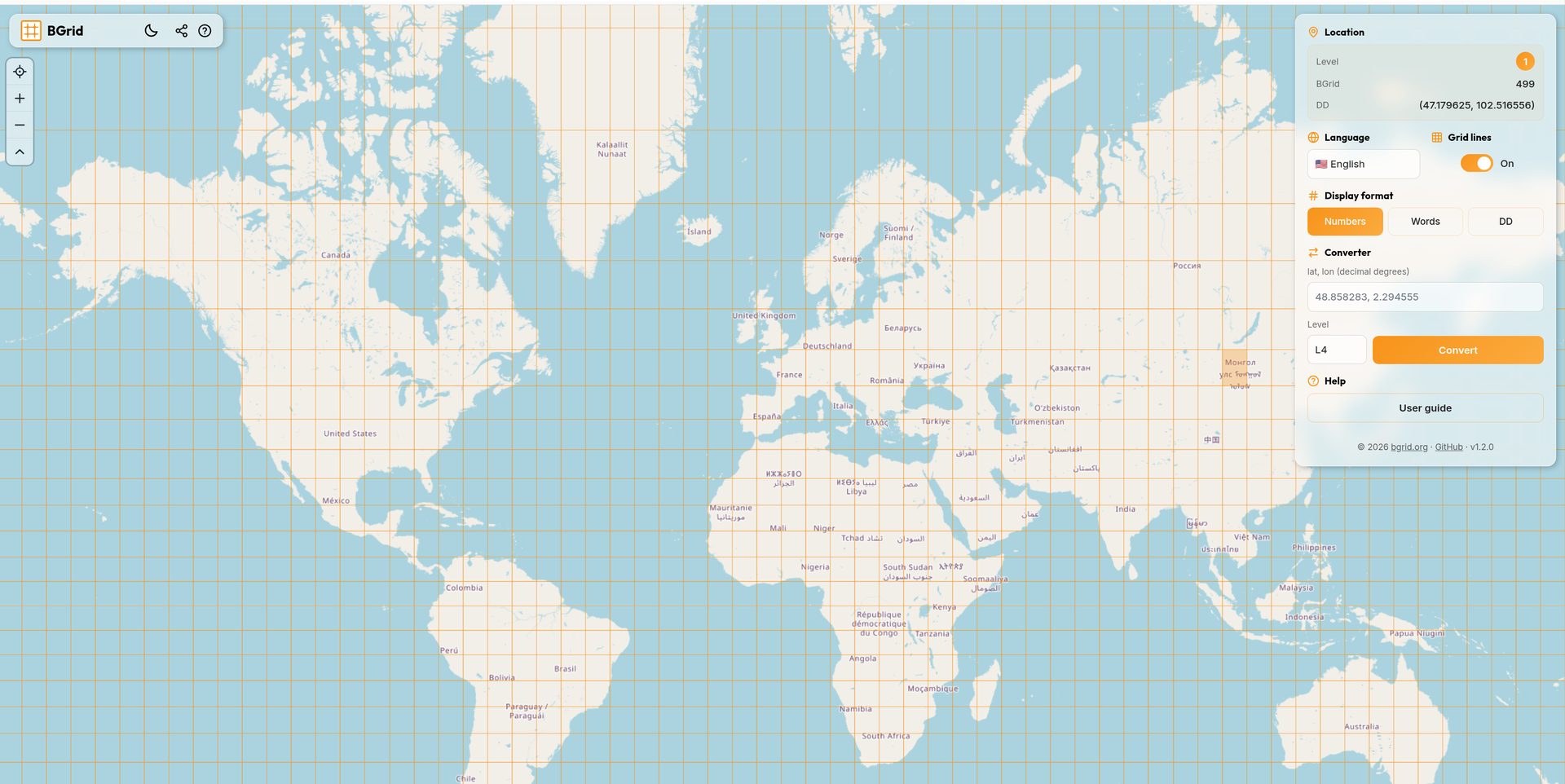
BGrid is a coordinate system created by our team and free to use. It divides the Earth into four levels of cells, with 2,048 divisions per level, from regions of about 249,000 km² down to cells of about 29 m². Each cell is written as words from the BIP39 list, so a location such as little airport aunt chief can be spoken, typed or stored in an asset without dealing with decimal coordinates.
Because you choose how many levels to share, you also choose the precision: one word points to a region, four words to a building. Try it at maps.bgrid.org.
Mining
Neurai uses KAWPOW, the ProgPoW variant introduced by Ravencoin. It is memory-hard and tuned for consumer GPUs, so there is no ASIC advantage to buy. Blocks arrive every 60 seconds with an initial reward of 50,000 XNA, and instead of a halving every four years the reward drops by 5% every 10 days, which gives a smooth emission curve.
Any KAWPOW-capable miner works on Nvidia and AMD cards, including T-Rex, TeamRedMiner, Gminer, NBMiner, SRBMiner and Rigel. You can mine on a pool or solo against your own node. The Mining page lists the software and the pools.
What runs today
- Node software. Neurai Core on mainnet. Version 2.0, with DePIN tokens and DePIN messaging, runs on the public testnet.
- Wallets. Neurai-QT and Electrum for desktop, the web wallet for any browser, Neurai Wallet for iOS and Android (non-custodial, based on BlueWallet), and the Neurai Sign browser extension for Chrome and Firefox. Third-party support from Komodo, Vidulum and OneKey.
- Neurai Swap. A non-custodial marketplace for trading assets against XNA. Asset and payment move in a single atomic transaction, so there is no escrow and no intermediary.
- Explorers and services. explorer.neurai.org and a public RPC gateway at rpc-main.neurai.org.
- Libraries. JavaScript packages under
@neuraiprojectfor keys, transactions, assets, RPC and DePIN messages, plus the C++ libraries for the ESP32.
What comes next: POSITRONIC
POSITRONIC is the next protocol upgrade. Development and wallet integration are finished, the public testnet is exercising it now, and a security audit is queued before the mainnet activation date is announced.
It brings 30-second blocks, script opcodes for covenants and transaction introspection (including OP_CAT), post-quantum addresses based on ML-DSA-44, the DePIN token, DePIN messaging and the MCP worker. Details in POSITRONIC.
Where to go next
- Quick Start to get a wallet and your first XNA.
- Mining to run KAWPOW on a GPU.
- Developer docs for the libraries, the RPC and the device examples.